

Crazy quilt by Mary Matilda Tarleton Leake (1856-1934)
Louisiana State Museum
Mary Matilda Tarleton Leake (1856-1934) won a prize with this crazy quilt entered in New Orleans's 1884-1885 World's Cotton and Industrial Exposition, depicting fair themes of Louisiana Industry and Cotton. Several crazy quilts were probably displayed at that fair as the style was a nationwide fad at the time.
Quilt Index Record: http://www.quiltindex.org/fulldisplay.php?kid=1B-3A-6E

A contender is this wool & silk embroidered and appliqued sampler made by Methodist Church members in New Iberia. But was it made in 1867? The style seems later.
Mary Matilda's quilt was the earliest Louisiana quilt with a date on it we could find, which surprised us at the Facebook group.

Rev A.E. Goodwyn, 1867
A contender is this wool & silk embroidered and appliqued sampler made by Methodist Church members in New Iberia. But was it made in 1867? The style seems later.

The DAR's Baltimore album was actually made years later and this Louisiana album seems likely to date from after 1880 during the nationwide fashion for embroidered quilts.

You don't see that kind of signature in 1869---it's more late Victorian.
Pictures from Jessica Hack who did the restoration work.
New Iberia is a little north of the Gulf of Mexico in the area of Louisiana that some cultural geographers call Acadiana, parishes (counties) with strong French cultural traditions.

New Iberia is the yellow star.
Mary Matilda Tarleton was also from a French
cultural area---New Orleans along the Gulf.

But we see no evidence of any particularly French needlework
traditions in either of these quilts. They could have been made in
Massachusetts, Michigan or Virginia.
So what were women in Louisiana stitching in the years 1840-1870 when seamstresses in New England and New Jersey were piecing friendship quilts and women in Baltimore and neighboring communities were appliqueing elaborate blocks? What was happening there in 1820 when chintz quilts were all the rage in the Carolinas?

Kay Triplett suggested this quilt from her collection
as a Louisiana album stitched before 1870.

A Louisiana album it certainly is. For the book Hidden Treasures: Quilts from 1600-1860 she did much genealogical research on the names, all of which she found in Claiborne Parish, which borders Arkansas in northern Louisiana.

Beautiful shot of the stenciled name of
Martha Eleanor Bibb Cole Day Zachry (1808-1895)
a Georgia resident for her first seventy years.
According to her Find-A-Grave website: "After 1880, she went to Louisiana to live with a son by her 1st marriage." She is buried in Dykesville, Claiborne Parish.

Louisiana Parishes
The name on the redwork embroidered block below, Mag Gleason, refers to Margaret Angelina Gleason (1845-1939) who married William Richard Lowe in 1880 and changed her name.

The Claiborne album quilt illustrates well the frustration in dating quilts by interweaving different types of evidence. Without a date on the blocks (or even better the sashing, border or back) we do not know when the quilt was set together. Blocks may have been signed, dated & kept for decades. Genealogy and family stories often conflict with patchwork style as in the New Iberia quilt above. Mag Gleason's album block is decorated with Turkey red outline embroidery, a technique hugely popular after 1880....

As is Mary E. Taylor's.
Were the blocks begun in one decade, added to and set together at a later date?

There's certainly no lack of quilts attributed to Claiborne County, Louisiana made AFTER 1880.

Unusual pickle dish variation attributed to Frances Kendrick Massey
in the "Camp Community" (Is this actually Campt?)
Claiborne Parish, Louisiana

The maker is probably Martha Frances Whitten Kendrick Massey (1866/7-1952) of Homer who married in 1901. The Louisiana project photographed three of her quilts found in a trunk. She's buried in Lafayette County, Arkansas.

Brother William Austin Kendrick (1852-1934) & family about 1894
based on 1892 birthdate of baby Oddie.
They moved to Texas about 1900.

Patchwork on the chair?
Fan-quilted blankets as backdrop.
The original question:
What's the earliest Louisiana patchwork quilt we could find in the literature or on-line?
Has evolved into
Why are there no reliably attributed Louisiana patchwork quilts made before 1870 or 1880?

Pink border between parallel cultures.
Below it French/African/Spanish traditions.
I have two guesses.
1) Women in the state's Southern areas were not members of a quilt-making culture. As we have seen in Pennsylvania where German speakers did not begin making quilts until about 1840 and in the Dutch Fork, North Carolina where German descendants did not begin the craft until the end of the 19th century, patchwork quilts tended to be a British import.
See a post on German bedding traditions here:
https://barbarabrackman.blogspot.com/2020/04/quilts-in-dutch-fork.html
See a post on German bedding traditions here:
https://barbarabrackman.blogspot.com/2020/04/quilts-in-dutch-fork.html

The darker the area the more French native speakers fifty years ago.
Traditional bedmaking customs dictated other types of coverings; traditional needlework forms did not include patchwork to any degree. It's only when people in the parallel cultures adopted that rather distinctive mainstream bedding style that quilts become common.

"An Acadian Quilting Party," perhaps photographed in the 1950s.
2) Why no early quilts made in Anglo-Louisiana above the map's pink line?

Quilt dated 1869, signed Mary A Turley (1854-1917)
Found in the Kansas Quilt Project, made in Indiana before
Mary came to Kansas to marry Levi Morgan in 1871.
This may be explained by lessons we learned in the Kansas quilt project. During the quilt craze along the Atlantic coast in the 1850-1870 period Kansas was settled by immigrants from those areas. Easterners could not bring much west but bedding was considered a necessity. Settlers brought their quilts (a mix of function and sentiment) and it isn't until the 1870s that we found Kansans beginning to create new patchwork bedcovers. Time and again we were disappointed to find mid-19th century quilts like Mary Turley Morgan's, which families attributed to Kansas, to have been made in the east.
See a post here:

When Louisiana women began stitching quilts about the same time as Kansans they adapted current styles popular in the Southern states from which they'd come and the patterns and fabrics their neighbors used at the time. They did not seem to recreate the older quilts they'd brought with them.
See a post here:

1876 Drusilla Showalter Cole, Mound Ridge, Kansas
Earliest date-inscribed quilt made in Kansas out of over 10,000 quilts examined
in Kansas Quilt Project.
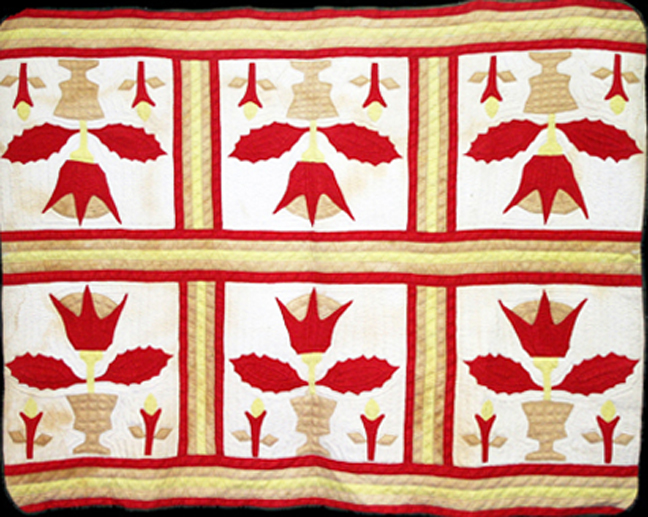
Quilt recorded in the Louisiana project, bought in Canton,Texas.
Owner thought it might be 1850 stitched by a slave, but size & style
(quintuple sash, fading solid fabrics & bold
applique) indicate it is post 1880.
Distinguishing a late-19th-century Louisiana quilt from a late-19th-century Arkansas or Texas quilt is a fool's errand. Sharing style across state lines must have been common---back immigration, regional fairs and quilters just visiting the relatives on the railroad networks.
We can make some pretty educated guesses as to dates even if we can't guess location without family history, so unless we find new dated examples reliably inscribed before 1870 we will have to assume quilting was a late-19th century craft in Louisiana.


Earliest fair record of quilts so far found in Louisiana, 4th State Fair results
in the New Orleans Times-Picayune, May, 1870
UPDATE from Teri Klassen:
Observation on state fairs and quilts:
"4th LA state fair was in 1870, meaning they started just after the Civil War (assuming they were continuous). This was at least a couple decades later than many eastern seaboard and eastern Midwest states (ie Ohio) started having agricultural fairs, which surely were a huge driver for the popularity of fine quiltmaking."
Good point, now we'll have to look at fair origins. When & where.
Next post:
What Louisiana quiltmakers did once they took it up.
See a preview of Lori Lee Triplett & Kay Triplett's 2019 book Hidden Treasures, Quilts from 1600 to 1860: Rarely Seen Pre–Civil War Textiles from the Poos Collection at this link:
https://books.google.com/books?id=adKcDwAAQBAJ&pg=PA31&lpg=PA31&dq=quilt+textile+collections+zachry&source=bl&ots=swu82fKGll&sig=ACfU3U2NZzpwpAfthphfYVE-6lBC2XUGkw&hl=en&sa=X&ved=2ahUKEwiu2KuLhInqAhWMSTABHSXBDQ4Q6AEwDXoECA0QAQ#v=onepage&q=quilt%20textile%20collections%20zachry&f=false


