Tuesday, December 17, 2019

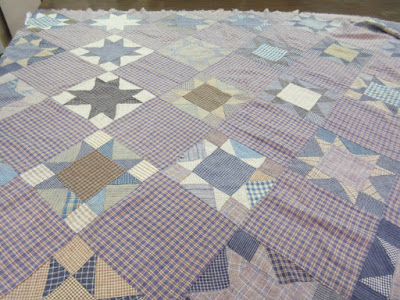
Alamance Plaids---Yarn Dyed Pattern


Alamance Plaid quilt, by a "member of the Gurley or 

Hines family, probably Margaret Gurley Hines (Mrs. Edwin Hines) 
(b. ca. 1852), Wayne County, North Carolina, 1880–1910. 
Cottons, cotton-wool mixtures." Colonial Williamsburg collection.


"Although fragile and much worn, the charming quilt documents the popular Alamance plaids made in that county of northern North Carolina since the mid-1850s. In 1880, seven mills in Alamance County were producing the popular cotton plaids, and by 1884, the Southern Plaid Manufacturers’ Association represented 2,300 plaid looms. By the early 1890s, the textiles were exported throughout the southern states and as far away as New York, California, and Wisconsin. The quilt itself is utilitarian in its choice of materials and design, making use of scraps and small pieces stitched together in a slightly haphazard pattern that echoes the popular crazy quilts of the day."
https://emuseum.history.org/objects/96359/quilt-pieced-from-alamance-plaid-cottons;jsessionid=7E3F3771855C95C1388867F879BA8DC1

Well said! But for those of us who live outside the South and never get to see a quilt like this in the cloth---We have questions. One of the problems is the confusion over terms. Is homespun spun on wheels and woven on looms at home? Can you tell an Alamance plaid from one milled in a different factory North or South? Just what is an Alamance plaid?

Lynn Lancaster Gorges and Suzanne McDowell have been working on questions about Alamance plaids for quite a while. They've examined the plaids in fifty plus quilts in Lynn's collection and quilt blocks and fabric swatches and read extensively about the history of Southern plaids.

From Lynn's collection

So here are some questions and answers from our Facebook page. Jo asked how we can distinguish between "homespun in relation to what was spun and woven at home and what was spun in mills, woven in mills?....How do we distinguish ?"

Now that is a tough question, which as Lynn said about all of these concepts, is not easily answered in a Facebook bite.

Library of Congress
Doris Ulmann photographed an unnamed woman
spinning in the upland South in the early 1930s.
My guess: She's showing how she spins wool.
Cotton is difficult to hand spin so factory-spun cotton
was often combined with hand spun wools.


 Southern fabric industry portrayed by Thomas Nast in 1882

We can be pretty confident that the majority of the yarn-dyed checks & plaid cottons we see in quilts made after 1880 were factory made. It's more an observation on context than being able to distinguish the hand versus the machine in the actual fabric unless you are using a microscope and have Suzanne's eye for weaving.

The seller advertised this quilt as having a homespun backing.
Do all the customers realize it's a look rather than a description of
how it was made?

Ad for "North Carolina Plaid Homespuns" & "Striped Homespuns"
 in a Raleigh newspaper in 1861, just before the Civil War began,
 describing factory-made cloth.
The rather mythical term goes back generations.

Technically the fabric above has nothing to do with home spinning or weaving. Homespun refers to style rather than technology. To most people today homespun means a yarn-dyed plaid or stripe in which the pattern is formed by different colors in warps and wefts.


Current woven designs like this "Homespun Gatherings" collection
 are often manufactured in India


In her book on the Black family quilts Laurel Horton described a similar backing as "a coarsely woven brown and white houndstooth check, an example of the ginghams produced widely by southern cotton mills...known generically as 'Alamance' plaids or ginghams."

Amy asked, "How does one differentiate between alamance and another plaid? Does the quilt need to be identified as southern first, then any plaids it contains are automatically alamance?"

From Lynn's collection
Coarse cottons of yarn dyed pattern.
Blue and brown combinations are often seen in the quilts.

Again we have a term with several meanings, style and technology. "Alamance plaid" is a look but also in a narrower sense any yarn-woven cotton pattern woven at the Alamance mills in Alamance County, North Carolina.

We can focus here on the late-19th-century/early-20th-century versions of Alamance plaids, which Lynn and Suzanne find to have a PIC count of 32 x 32 up to 40 x 40. PIC refers to the weft threads per square inch, the picks. The higher the number the finer the cloth. The quilt fabric we buy today ranges from a minimum of 60 up to 80.

The North Carolina project photographed this piece of plaid patchwork

Lynn:
"Suzanne and I found that the ["homespun" style plaids] indicates the use of single ply cotton and the fabric has a PIC count of 40 x 40 or lower, therefore making it a looser weave when inspected with a microscope. Often the weave looks tighter because of the sizing applied by the mills onto the fabric. Many manufacturing companies made cloth they called homespun. This was proven using newspaper ads and articles. We have found plaids that are truly home produced that are much finer PIC counts. Primarily we have found that manufactured homespun has more regular threads when viewed under magnification."


Lower numbers indicate the coarser fabric that seems so distinctive in these Southern style quilts.

Garment made from a coarse yarn-dyed cotton.
North Carolina Historic Sites

Homespun-style fabrics from Southern mills in North Carolina and other states were also called North Carolina Plaids, Pamlico Plaids, etc, writes Lynn.


Orange dots are counties we are talking about

 Alamance and Pamlico are two North Carolina counties and each had important cotton mills, the Alamance Cotton Mills and the Pamlico Cottons Ltd.


A 1922 article on yarn-dyed fabrics listed 20 mills, "manufacturers of well known and long established brands of woven colored fabrics of all descriptions." This movie-star-handsome guy T. Holt Haywood was the New York agent (or factor) for a group of textile mills. He seems to have been a Holt, the family behind Alamance County's mills and a leading force in manufacturing and marketing the Southern fabrics after the Civil War. The Holts started the Southern Plaid Association, a trade group with possibly 40 member mills, recalls Lynn.

It seems quite logical that the Holt family mills, the Alamance Cotton Mills, would become the popular generic name for the product, no matter where it was woven.

Lynn:
"By the late 1880’s into the 1890’s the plaids were selling for 3-5 cents per yard. Along with the plaids they were making striped jeans and checks/ginghams in homespun weight....
Bonnie found this string quilt with 2 yarn-woven patterns
on the back in North Wilkesboro, North Carolina, up by the 
Virginia line in Wilkes County. Virginia had plaid mills too, 
notably the Dan River mill. See her post here:
Lynn: 
"Many NC quilts continued to have plaid backs way into the 20th century because the yardage was so cheap women would buy it up and stash it. The most popular colors are blue and brown but there are also plaids with green and coral."

Quilt found in the West Virginia project but attributed to 
Caroline Forbes of Pitt County, North Carolina.

Lynn continues:
 "I am going to confuse y’all more. Suzanne and I have also found some plaids like the ones we call southern plaids in New England. So were they made there or sold up there? We do know that much of the equipment used for the start of the southern mills came from New England. We also know that these southern plaids were sold in South America, New Orleans, Louisville, Philadelphia and many other places. We have ads in old newspapers to back that up."
Collection of the North Carolina Museum of History, 
Associated with Edith Uzzell (1837-ca. 1914), Wayne County, North Carolina
Curator Diana Bell-Kite posted this picture. I like the term "Associated with."

Lynn writes:
"I grew up in Wayne County. So far the most plaid quilts have been documented in Wayne County. That is maybe because it was the HUB of the railroad in the east coast. Due to that bales of plaids came into Goldsboro often. A bale had 1,000 yards in it. Check out newspapers.com for ads in Goldsboro around 1890. Weils General Store often sold them.
 H. Weil & Bros., Wholesale & Retail
North Carolina Office of Archives and History

Lynn's collection


So all we can come up with here is that both terms homespun and Alamance plaid are determined by the context.

An Alamance plaid is a style---a common style of Southern plaids, some of which were produced in factories in Alamance County, North Carolina. Some of which were not.

Calling this style of quilt pieced of yarn-dyed coarse cottons
an Alamance Plaid Quilt refers more to its style than the source
of the fabrics, but the term does communicate. The style was popular maybe
1890-1930, particularly in the South and particularly in North Carolina.

Quilt dated 1928 from an ebay seller in Davidson County, North Carolina

And "homespun", like "hot dog", tells you nothing about how the product was made.

Dogs in Sweaters quilt pattern by Elizabeth Hartman

Sunday, November 24, 2019

Tobacco Sacks


Shelly Zegart donated this quilt of recycled fabrics to the Art Institute of Chicago. She found it in Kentucky. The date on it is now 1930-1945.
https://www.artic.edu/artworks/158438/tobacco-sacks-quilt

As Teri Klassen noted: "A curious concept, celebrating (?) her construction material." Most quilters did their best to disguise the source of re-used fabrics, which sometimes makes it difficult to know the source for the fabrics.


Tobacco sacks or bags are the common packaging for loose tobacco to be smoked in a pipe or rolled into a cigarette. They are stitched along one side and the bottom and gathered at the top where a string (usually yellow) is threaded through a stitched casing.


In the time period we are talking about (20th century up to about 1970) the cotton sacks were manufactured by a few large bag companies (with a good deal of at home work by women) and sold to tobacco companies that added their identification, often with an easily removable paper label. It would be tough to throw away all that cotton cloth so many removed the stitching and pressed the rectangles open to be re-used as unbleached muslin or dyed for patchwork.

Sacks for George Washington tobacco were printed with the label
making them less amenable to undisguised recycling.
The patchwork comforter is by Belle Aller of Ohio...

Recorded by the Oregon project and the Quilt Index.
No doubt on the source here.

Collection: Washington state's San Juan Island Museum

The maker left the paper packaging on the Bull Durham sacks and seems to have just laid the sacks front and back on a backing with yellow strings still in place. 

How can we tell if a quilt has recycled tobacco sacks in better disguise?


Some family histories tell us, as in one recorded by Teri Klassen, pictured in her book Tennessee Delta Quiltmaking. Verniece Staggs (1915-2002) made the quilt about 1952 in Brownsville, Tennessee according to her daughter-in-law.
"She would take tobacco sacks and unravel them and wash them, and then she would dye them, and she would stack them up until she got enough to piece them together"

"Mrs. Bill Staggs exhibiting a quilt made from tobacco sacks
 which she ripped up, dyed, and pieced. Pie Town, New Mexico"
Photo by Russell Lee, 1940
Library of Congress
An unrelated Mrs. Staggs with her own story.

Fannie Cox Blunt (1840-1933) Grand Cane, Louisiana
Louisiana Project

Fannie's granddaughter brought in 4 quilts, this one:
"A 'Sunday quilt' used on Sundays and special occasions. Tobacco sacks hand dyed. Green faded to beige by frequent 'sunning.' (Sun airing?)" 
Had she not told the story there'd be no sure way to know the source of the fabrics.


The Louisiana project also recorded this story about a friendship quilt brought in by Eva Graves Pardue who worked on the quilt in 1943.
"Once a month, the twenty members of 'The Golden Rule Club' would meet in the Dean Community of Union Parish, Louisiana....Each lady answered roll call by presenting a quilt block with her name in it. All the blocks were made by the same pattern and most of the light colored fabric in the blocks came from Bull Durham tobacco sacks. The quilt blocks were given to the person who had a birthday in that month." 


Nancy Jane Kinyon Thompson's great granddaughter brought this well-used quilt to show the Oregon project.
"In the evenings she loved to sit in her rocking chair smoking her clay pipe....she smoked mostly 'Union Header' and made quilts out of the empty bags."
The sacks didn't just come from the male smokers in the family. Smoking tobacco (and using snuff) were common habits among women of earlier generations. Stacy Rawlings recalled her Ozark mountain relatives who "finished each day sitting on the porch together visiting and smoking pipes. That was the 1960s. They only smoked in the evening."

In the 1940s the tobacco sack companies were producing a billion sacks a year and a lot of  left-over rectangles.


The rectangles lent themselves well to Brickwork or Brick Wall quilts of rectangles and we can often guess the source by the shapes used.

Puff quilt made of sacks dyed and stuffed by the maker
Effie Roe of Kerrville, Texas
Collection of the Briscoe Center.


Online auction a while ago.

Laura Curl Syler remembered she had a brick top that was never used----
"My grandmother and great-grandmother dyed tobacco sacks pink and blue for my mother's baby quilt. When she was born my grandmother decided the blue just wouldn’t do.... Made in Pendleton, Texas just north of Temple."

Lynn Lancaster Gorges has one too, "made of dyed tobacco bags made by my paternal grandmother."

From John Sauls's inventory

As Terri Klassen observed: "Seems like tobacco sack quilts were a fad or fashion, not just to be thrifty."

Jean Odom who worked in a Tennessee tobacco company in the 1970s remembered colored sacks for bagged tobacco. 
"I have red, yellow, white, off white, and blue check bags....Do not make the assumption that colored bags in a quilt were necessarily home dyed."
Quilt by Emaline Savoze Jones of Bedford County, Tennessee.

From the Tennessee project and the Quilt Index.

Her grandson said the fabrics were recycled sacking. The project reports: "Some of the tobacco sacks were dyed by the manufacturer; the grandmother pieced the quilt." Does it mean Emaline is the manufacturer or the tobacco sack company as the dyer? After reading Jean's comment I think they mean the sacks came in these colors.

Recycled materials also included the yellow string from tobacco sacks. 

Quilt by Josepha Rodriguez of New Mexico, photographed for Dorothy Zopf's Survivng the Winter: The Evolution of Quiltmaking Through Two Cultures in New Mexico. The yellow ties are saved from sacks.

The tobacco sack industry offered work to women in sewing the bags and in finishing them with the string.
See a story about a North Carolina quiltmaker who stitched sacks as piecework for the tobacco companies in Winston Salem.

https://womensworkquilts.blogspot.com/2019/11/sewing-for-money-in-yadkin-county.html?fbclid=IwAR3MLIyT5cEM7X9DMquPX5CVCLyzuSYEpni3wSC7bTm0iDg0

And a post about tobacco stringing as Women's Work featuring a website from the University of North Carolina.
The woman on the right measures off the yellow string,
the others insert string into the gathered edge at the top of the sacks.

Sunday, November 10, 2019

Regional Pattern: Palm Leaf

Here's a distinctive applique pattern based on rotational symmetry,
a scroll-like center shape with tulip-shaped flowers on the north/south
axes and a complex leaf in the corners.


The photo (with a little color correction) is from the North Carolina project, attributed by her descendants to Mary (Molly) Frances Lynch Phillips (1868-1936) who lived her life in Yadkin County, North Carolina. They called it Palm Leaf, which is as good a name as any. Family and documenters date it to last quarter of the 19th century.


The design is a good first pattern focus as we covered it pretty well on our Facebook page.
Bill Volckening posted an example he has donated to the International Quilt Museum because
they have another one in the Carlson collection in an almost identical pattern.

Bill's is the one with the extra parts floating in the bottom.

When documented by the NC project it was in the collection of the Wake County Historical Museum in North Carolina. Signed in ink: "Francis" on the reverse. Another photo tells us:

By Julia A Pearce, Randolph County
Collection: North Carolina Museum of History.

Identical to this one except for fading....

From Mark French's ebay store

We found several others with the pierced corner leaves and the tulip.

This one has been recorded several times, sold on ebay as from
Davidson County, North Carolina.


It's an exception to the style rule that the pattern is appliqued of solid color fabrics.
The background here is a white shirting and there is a red print in the sash. The tulip is
a little different too--more like a cotton boll (another topic-another post.)

Dealer Xenia Cord showed it in her booth at AQSG recently.

From a Brunk auction
Almost all the examples we posted were four-blocks,
which means those blocks are rather large---Molly Phillips's is about 35 inches?
And many of them had a pieced sashing.

Another from Mark French, a medallion format exception to the 4-block style. The 12 smaller blocks are missing the tulips. We decided this is probably 1850-1880. The greens in this well-washed and well-worn quilt are fading like overdyed natural dyes rather than the synthetics seen after 1880. 

Then we got into the smaller blocks without the tulips.

Cathy Erickson posted several similar designs in album/sampler quilts from her collection.
No tulips but pierced leaves stitched in reverse applique and the scroll in the center.

The scroll like center often has a square in the center.


We looked for examples of just that center scroll in album quilts and repeat block patterns
but found none.

We did find several examples of the center with other images in the corners
like this one that Kay Triplett posted.

A relative

More relatives with flowers, pineapples and leaves from my Encyclopedia of Applique.
None have names and all were drawn from mid-19th-century albums.

From a Maryland album dated 1846
Maryland Historical Society collection


It appears that the pattern (without the tulips) first appeared in the Southern quilt style we call Baltimore Albums. The symmetries, techniques, fabrics etc. are a common aspect of these quilts that date from the mid 1840s to the mid 1850s---a narrow window of time. The blocks were small; there was little room for tulips.


Cathy Erickson went through the Owen Jones index to classical ornament published in 1856. The Grammar of Ornament groups decorative arts and architectural ornament by culture. The band decorations above are from Greek vases.

Owen Jones notes that most of the various leaf shapes do not represent any particular
plant. 
"Being produced by one or two colours, they all depend for their effect on pure form; they have mostly this peculiarity, that the groups of leaves or flowers all spring from a curved stem, with a volute at either end...."

A volute---a curlicue
Band decoration reformatted in Photoshop for rotational four-way symmetry.
One could have traced a design four ways in 1845.

Cathy wrote: "interesting to see that a number of them have the circular shapes at the bottom of the design. As a quilter I would not try to make individual petals but shortcut to just indentations for each petal."

From a Baltimore quilt made for Sarah Shaffer Weiss,
sold at a Skinner Auction.

It would seem that this applique pattern developed in Baltimore about 1850 when seamstresses there were experimenting with applique designs drawn from classical motifs. The pattern was never very widespread but seems to have inspired more than a few quiltmakers.

The Peabody Essex Museum in Massachusetts owns this
sampler, recorded by the Massachusetts project that does NOT
look Southern.

In the collection of the American/International Quilt Association.

The four-block from the Carlson collection at IQM.

The design was revived about 1900---bolder, larger and with an added tulip to fill the blank spaces.


Four block without the tulip posted by Lisa Rue Dickson

Lucy Joseph Whitley Hardison (1862-1952), Martin County
North Carolina project
No tulip, no reverse applique.


Collector Sharon Waddell posted this quilt top
with a setting pattern similar to  Molly Phillips's at the top
 of the page. The scroll here is four hearts.

Source? Fading greens to dun-colored tan indicate after 1880....

Could be way after 1880, here's an ebay quilt dated 1943---familiar components.
May have been appliqued in 1927, quilted in 1943 as there are 2 dates.

The Palm Leaf would look good in chrome orange and olive-green solids.

Many of us make quilts as well as study and collect them.
It's easy enough to make a pattern of sorts in Photoshop.
Print this out on an 8-1/2" x 11" sheet.


What Have We Learned From the Palm Leaf?

How important classical decorative arts were to what is often classified as folk art.
It's often silly to make a distinction.

Source?

And it is interesting how several of these Southern classic quilts first appear in album samplers in the 1840s' & '50s and then two or three decades later as repeat blocks.

Reproduction made by Susan Cummins Derkacz
of New Braunfels, Texas in 2001.